
- 28 May 2026
- 3 min read
- By Claire Ryan
Queensland property prices keep climbing as headwinds gather
Queensland’s property market continued its upward run through the March 2026 quarter, with statewide median sales prices rising for houses and units and gains recorded across virtually all major regions, despite growing headwinds beginning to test confidence.
The Real Estate Institute of Queensland’s (REIQ) latest median sales data for the March 2026 quarter (January – March 2026) show Queensland’s housing market continues its northerly trajectory, underpinned by tight supply conditions and strong underlying demand, even as rising interest rates, global uncertainty, tax reforms, and weakening consumer sentiment cloud the outlook.
The statewide median house price rose 4.21% over the quarter to $990,000 and was 15.7% higher over the year. For units, the statewide median increased 4.81% over the quarter to $817,500, and 17.19% over the year.
Brisbane’s median house price rose 3.18% over the quarter to $1.46 million, while units increased 6.67% to $880,000. Across Greater Brisbane, median house prices rose 5.75% to $1.15 million, while unit prices increased 5.74% to $837,500 over the quarter.
Among the major Brisbane LGAs, Moreton Bay recorded the strongest quarterly growth for houses, up 5.3% to $1.053 million, while Ipswich led quarterly unit growth, rising 7.42% to $709,000.
In the tourism markets, Noosa posted the strongest quarterly house price growth, surging 8.39% to $1.68 million, while the Gold Coast unit market rose 4.47% to $935,000 and Noosa units lifted 3.15% to almost $1.23 million.
Across regional Queensland, annual growth remained especially strong, with Rockhampton and Toowoomba both recording 18.93% annual house price growth, while Rockhampton also led the state for annual unit growth at an exceptional 33.55%.
REIQ CEO Antonia Mercorella said Queensland’s market had so far proven remarkably resilient, but it was clear that stronger headwinds were beginning to gather.
“Up until the end of March, there were no obvious signs of a slowdown just yet – price growth has continued right across the board, and Queensland is outperforming many other parts of the country – but the mood in the market is becoming more cautious,” Ms Mercorella said.
“We’re seeing more fear and trepidation creep into decision-making – people are asking what comes next if they make a move, how much further borrowing costs could rise, and what broader economic pressures might mean for their household budget.
“Meanwhile, existing and prospective investors are still reeling from recent federal budget announcements proposing changes to negative gearing and capital gains tax reforms.
“These material and unexpected taxation changes have created nervousness amongst the investor community and anecdotal feedback is that investor confidence has taken a dent.
“This is creating a market that is still performing strongly on paper but is increasingly shaped by caution.”
Ms Mercorella said at the same time, the fundamentals that have been driving this market have not disappeared.
“Listings remain tight, new housing supply is still not where it needs to be, and Queensland’s strong population growth continues to sustain demand,” she said.
“The question now is not whether Queensland property has proven to be strong, but how the market will handle the global and local headwinds on the horizon.
“Affordability constraints are deepening, consumer confidence has taken a hit, and that may start to moderate the pace of growth, even if supply pressures continue to place a floor under prices.”
Recent national housing data shows Queensland is making progress, but remains off pace in housing delivery. Under the National Housing Accord, Queensland is expected to contribute around 49,300 homes each year. Based on our performance of 32,900 completed dwellings over the last 12 months to the December 2025 quarter, Queensland is approximately 33% behind target.
Looking forward, building approvals in Queensland’s pipeline were running at 3,975 dwelling units in trend terms in March 2026 (3% below the monthly target of about 4,100 dwellings), while elevated construction costs and capacity constraints continue to challenge feasibility.
Ms Mercorella said while market conditions were becoming more complex, Queensland property continued to show an ability to absorb shocks better than many expected.
“Queensland has built a reputation for resilience over recent years, but resilience should not be mistaken for invincibility,” Ms Mercorella said.
“If governments want to preserve a pathway to home ownership while maintaining a healthy property market, supply has to remain the priority.
“We need sustained action to boost housing delivery, improve productivity, and make it easier to bring the right mix of homes to market.
“Pathways to home ownership should be a focus but continued investor activity is also a key priority to ensure the rental population is catered for and rental prices are kept in check.”
HOUSE MARKET INSIGHTS
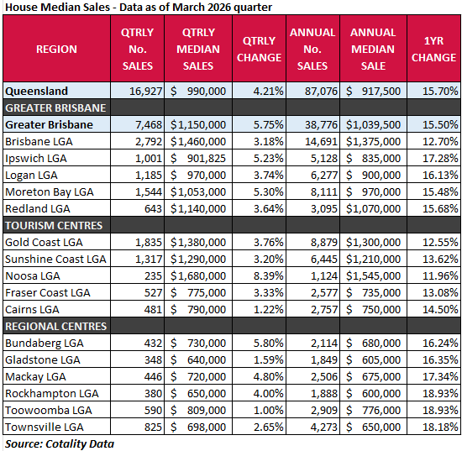
Queensland’s house market continued to perform strongly in the March 2026 quarter, with the statewide median sale price rising 4.21% over the quarter to $990,000. On an annual basis, this represented a 15.7% increase to an annual median of $917,500.
Across Greater Brisbane, the quarterly median house price increased 5.75% to $1.15 million, with the annual median reaching $1.039 million, up 15.5% year-on-year. Within the southeast corner, Moreton Bay recorded the strongest quarterly growth among the major Brisbane LGAs, rising 5.3% to $1.053 million, followed by Ipswich up 5.23% to $901,825. Brisbane LGA lifted 3.18% over the quarter to $1.46 million.
Among the tourism centres, Noosa led quarterly house price growth, surging 8.39% to $1.68 million, while the Gold Coast rose 3.76% to $1.38 million and the Sunshine Coast lifted 3.2% to $1.29 million. In the regions, Bundaberg recorded the strongest quarterly growth at 5.8% to $730,000, while Mackay rose 4.8% to $720,000 and Rockhampton climbed 4% to $650,000.
Looking at annual growth, it was regional Queensland that again stood out. Rockhampton and Toowoomba both recorded annual median house price growth of 18.93%, followed by Townsville at 18.18%, Mackay at 17.34%, and Ipswich at 17.28% — underlining the continued strength of markets where relative affordability and lifestyle appeal remain key drawcards.
The highest volume of quarterly house sales was recorded in Brisbane (2,792 sales), followed by the Gold Coast (1,835), Moreton Bay (1,544), Sunshine Coast (1,317), and Logan (1,185).
UNIT MARKET INSIGHTS
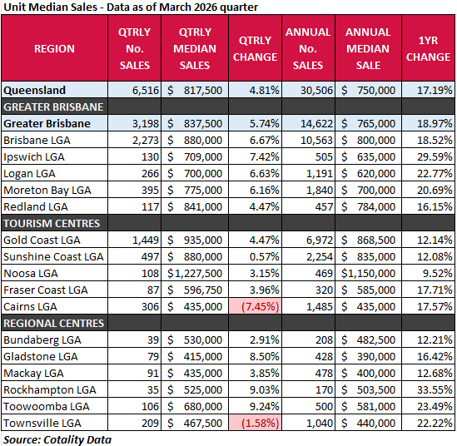
Queensland’s unit market again outpaced houses in the March 2026 quarter, with the statewide median sale price rising 4.81% over the quarter to $817,500. Over the year, this represented a 17.19% increase, with the annual median reaching $750,000.
Across Greater Brisbane, the quarterly median unit price increased 5.74% to $837,500, with annual growth climbing 18.97% to a median of $765,000. Within the southeast corner, Ipswich recorded the strongest quarterly growth among the major Brisbane LGAs, rising 7.42% to $709,000, followed by Brisbane LGA up 6.67% to $880,000, Logan up 6.63% to $700,000, and Moreton Bay up 6.16% to $775,000.
Among the tourism centres, the Gold Coast rose 4.47% over the quarter to $935,000, while Noosa increased 3.15% to $1.227 million and the Sunshine Coast edged up 0.57% to $880,000. Cairns was the outlier, with its quarterly median unit price falling 7.45% to $435,000, despite still recording strong annual growth of 17.57%.
In the regions, quarterly unit price growth was particularly strong in Toowoomba - up 9.24% to $680,000, Rockhampton - up 9.03% to $525,000, and Gladstone - up 8.50% to $415,000.
Looking at annual growth, Rockhampton led the state with an exceptional 33.55% increase in its annual median unit price to $503,500, followed by Ipswich at 29.59%, Toowoomba at 23.49%, Logan at 22.77%, and Townsville at 22.22%.
The highest volume of quarterly unit sales were recorded in Brisbane (2,273 sales), followed by the Gold Coast (1,449), Sunshine Coast (497), Moreton Bay (395), and Cairns (306).
DAYS ON MARKET INSIGHTS
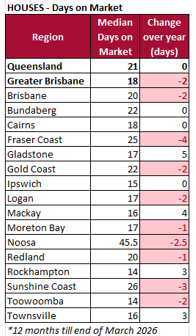
Selling conditions remained brisk across most Queensland markets in the March 2026 quarter. Across Queensland, the median days on market for houses held steady at 21 days, unchanged over the year. The fastest-moving house markets were Rockhampton and Toowoomba (both 14 days), followed by Ipswich (15 days), and Mackay and Townsville (both 16 days). By contrast, Noosa remained the slowest market at 45.5 days, consistent with its premium price point and tightly held stock.
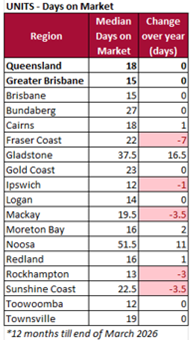
For units, the statewide median days on market also held firm over the year at 18 days. Ipswich and Toowoomba were the fastest-moving unit markets at 12 days, followed by Rockhampton at 13 days, Logan at 14 days and Brisbane at 15 days. While most markets remained relatively tight, Noosa remained the slowest unit market at 51.5 days, while Gladstone recorded a notable blowout in selling time, rising 16.5 days over the year to 37.5 days.
Notes to Editors: ENDS Media enquiries: Read another media release from the REIQ: Queensland claims five national wins at real estate awards. Or browse our suite of media releases.
Claire Ryan, Media and Stakeholder Relations Manager, The Real Estate Institute of Queensland
M: 0417 623 723 E: media@reiq.com.au
You might also like
View All Articles
View All Articles



Start your Real Estate Career
Need help? 1300 697 347 or contact us