
- 31 Aug 2026
- 3 min read
- By Claire Ryan
Queensland property market takes a breath after years of rapid growth
Queensland’s residential property median sale price eased modestly over the June 2026 quarter as buyers, sellers and investors adjust to higher borrowing costs and recent taxation changes.
While the state’s extraordinary growth run appears to have paused, annual gains remain firmly in double digits, and most major markets continue to hold their ground.
The Real Estate Institute of Queensland’s (REIQ) latest median sales data for the June 2026 quarter (April – June 2026) shows a broad moderation in price growth, with nine of the 16 major house markets recording soft quarterly growth, two remaining stable, and five experiencing dips as market conditions become less frenetic than in recent years.
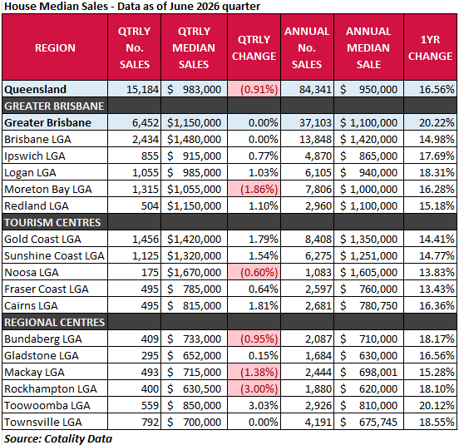
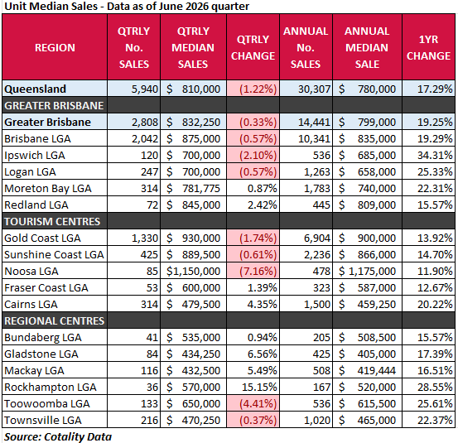
Over the quarter, the statewide median house price dipped -0.91% staying just shy of the $1 million mark at $983,000, while still recording annual growth of 16.57%. For units, again the statewide median eased -1.22% over the quarter to $810,000 but remained 17.29% higher than a year ago.
For houses, Brisbane and Townsville held firm over the quarter at $1.48m and $700,000 respectively. Whereas Toowoomba kept climbing by 3.03% to $850,000, potentially reflecting buyers seeking greater value outside the southeast corner.
REIQ CEO Antonia Mercorella said the quarter was characterised by minor movements, relative to Queensland’s exceptional property price growth over recent years which outperformed much of the country.
“Queensland’s property market has spent several years operating at full throttle, so any return to more regular pace will take a bit of adjustment – especially when it comes to buyers and sellers’ expectations,” Ms Mercorella said.
“It is important to put these results in perspective and not view them through a doom and gloom lens. While the quarterly medians have edged back in some locations, they represent a steadying market.
“After years of rapid gains, the market is taking a breath.”
Ms Mercorella said in a state as vast as Queensland, it was not easy or wise to generalise.
“While we talk about the Queensland market as a whole, it’s unrealistic to think you can paint the entire state with the same broad brush – given the sheer size and diversity of Queensland, the markets are much more nuanced,” she said.
“Looking at the major house markets within Queensland this quarter, our capital city remains unchanged, Toowoomba continues to forge on quite strongly, and we’re still seeing prices rising across most regions despite the slight dip in statewide figures.”
She said feedback from agents suggested market conditions were becoming more measured.
“Agents are telling us the buying frenzy is well behind us and we’re seeing the return of a more measured marketplace,” she said.
“For experienced agents, these conditions aren’t unusual at all. It’s a return to traditional, old fashioned real estate where with more rounded campaigns, more due diligence being undertaken and longer days on market.
“It’s the kind of market that Queensland operated in for many years before the extraordinary conditions of the past six years.”
Ms Mercorella said the next two quarters of data would be telling on whether this wobble becomes an established trend or proves temporary, picking up with Spring selling.
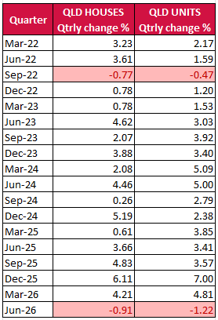
“The last time statewide quarterly medians moved backwards was in the September 2022 quarter, during a period of rising interest rates and economic uncertainty,” she said.
“That softness ultimately proved short-lived because Queensland's underlying fundamentals remained intact, and we continue to see many of those same strengths today.
“If we do settle into a quieter, slower rhythm, we know real estate has always been a long-term investment. Most property owners have built up a substantial cushion through gains, while more recent buyers have generally been assessed against stricter lending conditions.
“As for buyers or sellers, the current cautious environment is not a particularly advantageous position from either point of view.
“Sellers are contending with a smaller and more hesitant buyer pool, while in some cases, still anchoring expectations to the exceptional results achieved during the steep growth spurt.
“Meanwhile, buyers may have gained a little more time and negotiating power, but they’re not feeling optimistic, and are facing affordability constraints and uncertainty around finance. The reality is that they still need to meet the market to get a foot in the door.
“This is reflected in the decline in loan activity - Queensland’s new housing loan commitments fell 5.9% to 29,543 in the June 2026 quarter, slightly exceeding the national decline of 5.4%. First home buyer commitments declined by 1.2% over the quarter, while property investors materially led the fall, down 10.1%.”
Ms Mercorella said consumer confidence would be the critical ingredient from here.
“Some households are delaying major financial decisions because they want greater certainty around the economy, tax policy, interest rates, and their personal finances,” she said.
“But life doesn't stop. People still need to buy, sell, upsize, downsize and relocate, and Queensland continues to offer the population growth, employment, lifestyle factors and Olympic optimism that support housing demand and growth in the long term.
“While conditions may be less intense than we've become accustomed to, the fundamentals underpinning Queensland property remain remarkably solid.”
House market insights
Unit market insights
Queensland quarterly median sale price growth
Lending indicators
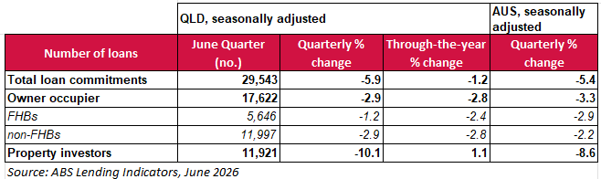
Share of housing lending by borrower type, QLD, seasonally adjusted
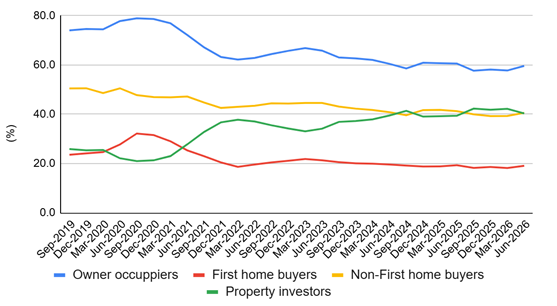
Source: ABS Lending Indicators, June Qtr 2026
Notes to Editors: ENDS Media enquiries: Read another media release from the REIQ: Forty real estate professionals elevated to REIQ Fellowship. Or browse our suite of media releases.
Claire Ryan, Media and Stakeholder Relations Manager, The Real Estate Institute of Queensland
M: 0417 623 723 E: media@reiq.com.au
You might also like
View All Articles
View All Articles



Start your Real Estate Career
Need help? 1300 697 347 or contact us